Choosing the right thermal covering for windows is often a battle between two competing desires. On one hand, you want a home that stays warm during a biting winter in Oxford or Northampton. On the other, you’ve likely spent a significant amount of money on your property’s architecture, those expansive bi-fold doors in the kitchen or the sleek, minimalist frames in your lounge.
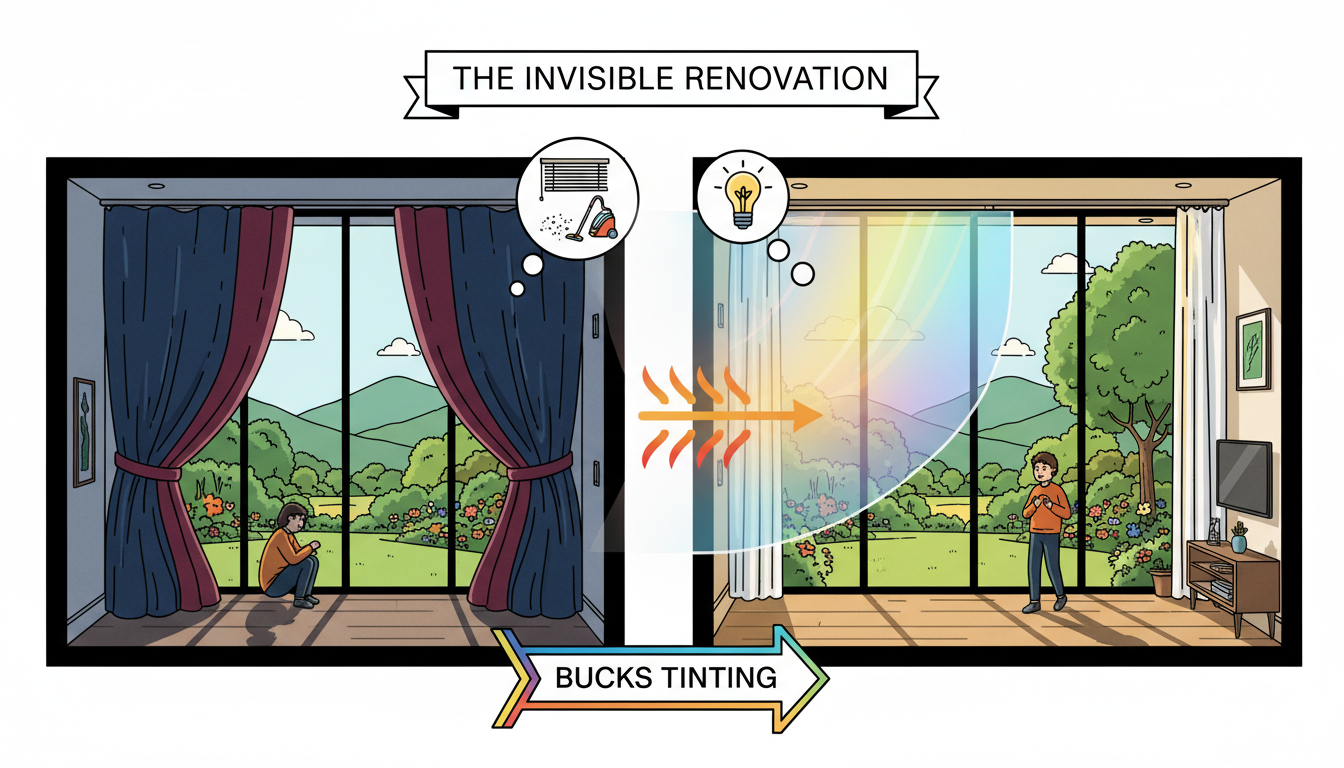
Usually, the "solution" to a cold room is to buy heavy thermal blinds or thick curtains. But here is the problem: the moment you close them to stop the heat loss, you’ve effectively turned your beautiful, light-filled home into a dark box. You’ve paid for a view of the Chilterns or a landscaped garden in Buckinghamshire, only to cover it up for six months of the year.
At BucksTinting, we believe there is a more sophisticated way to optimise your home’s temperature. We call it "The Invisible Renovation." By using advanced window film, you can create a permanent thermal barrier that rivals expensive shutters, all without losing a single lumen of natural light or a centimetre of your view.
The Problem with "Bulky" Thermal Coverings
When people think of a thermal covering for windows, their minds go straight to fabric. Whether it’s a thermal roller or a thermal blackout drape, these products rely on creating an air gap between the fabric and the glass.
While they do help with insulation, they come with three major "lifestyle taxes":
-
Visual Clutter: Even the most expensive blind adds bulk to a window frame. If you have spent years perfecting a minimalist interior in London, a chunky thermal housing unit is the last thing you want to see.
-
The "Always On" Requirement: For thermal blinds to work, they must be closed. This means you’re choosing between being warm in the dark or freezing in the light.
-
Dust and Hygiene: Unlike a glass surface, curtains and fabric blinds are notorious for capturing allergens and dust, requiring constant maintenance to stay fresh.
Professional window film removes these issues entirely. It is a "retrofit" low-E coating that bonds directly to your glazing. It doesn't move, it doesn't gather dust, and most importantly, it doesn't hide the architectural character of your home.
Window Film vs Blinds for Heat Retention: The Science of the U-Value
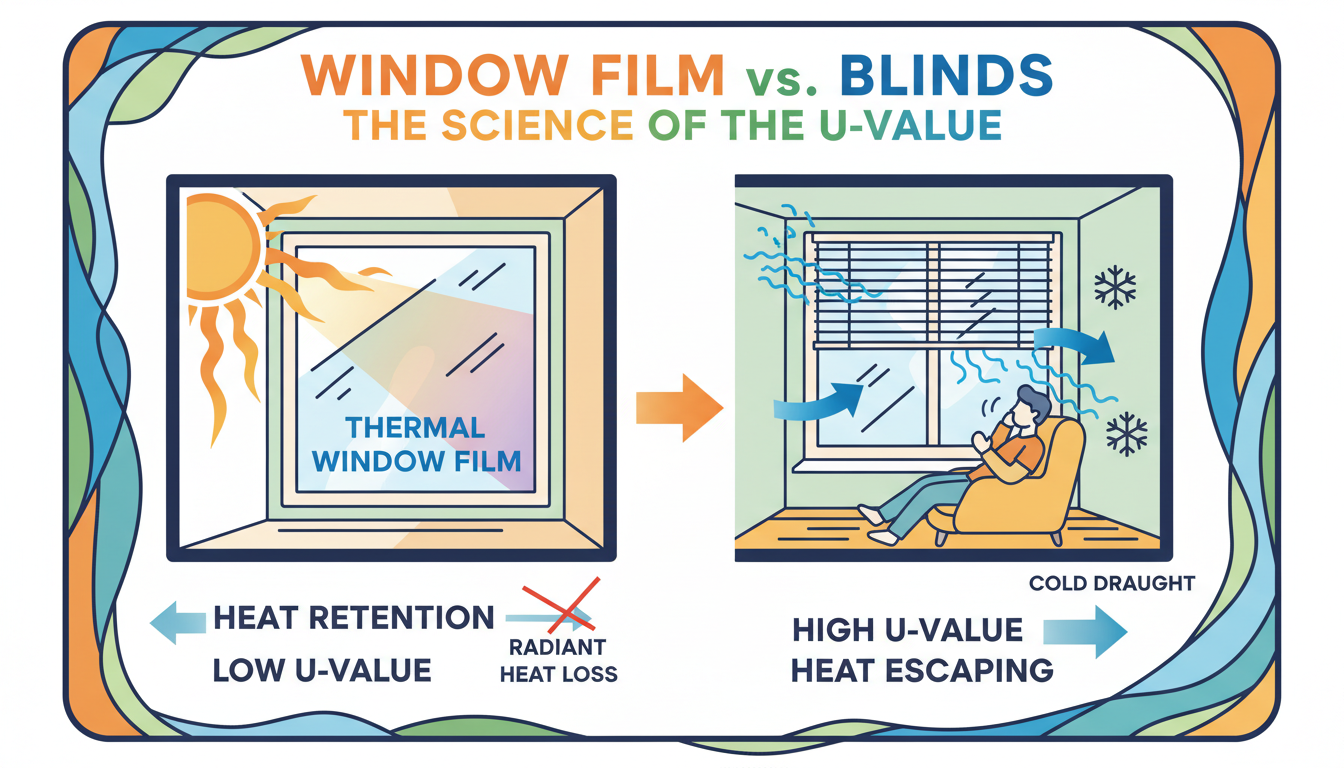
To understand why window film is such a formidable thermal covering for windows, we have to talk about the u-value. In simple terms, the u-value measures how much heat is escaping through your windows. The lower the number, the better the insulation.
Most older double glazing units have a u-value that leaves much to be desired. You might feel a "cold draught" near the glass, even if the window is perfectly sealed. This isn't usually a draught; it’s "radiant heat loss," where the warmth of your room is being sucked toward the cold glass surface.
Thermal window film reduces this effect by capturing heat and directing it back into the room. It essentially upgrades your double-glazed unit to perform closer to the standards of expensive triple glazing, but at a fraction of the cost of replacing the entire unit.
The "Open-Plan" Frustration: Sliding Doors and Floor-to-Ceiling Glass
If you live in a modern property in Guildford or a renovated terrace in London, you likely have a large glass door leading to the garden. These are the pride of the home, but in the winter, they are essentially giant "thermal holes" in your wall.
Finding a thermal covering for windows of this size is a nightmare. Large curtains are heavy and expensive, and motorised blinds often fail or look industrial. This is where window film insulation prevents that heat from escaping without interfering with the operation of the door.
Because the film is only a few microns thick, it doesn't affect the clearance of your sliding or bi-fold mechanisms. You get the energy efficient performance you need while maintaining the seamless "inside-outside" flow that your architect intended.
Solar Control Film vs Conservatory Blinds: A Year-Round Solution
One of the biggest benefits of choosing window film over traditional thermal blinds is that it works as a two-way street.
In the summer, your conservatory likely becomes a greenhouse. Conservatory blinds are often used to block the sun, but they trap the heat between the blind and the glass, eventually radiating it into the room anyway. Solar control film works by capturing heat before it even enters the room, keeping the space significantly cooler.
Then, when winter arrives, that same insulating window film is busy directing it back, meaning your internal heating stays where it belongs. It is a thermal solution that helps save energy all year round, unlike a thermal blackout curtain that only serves a purpose for half the year.
Secondary Glazing vs. Thermal Window Film
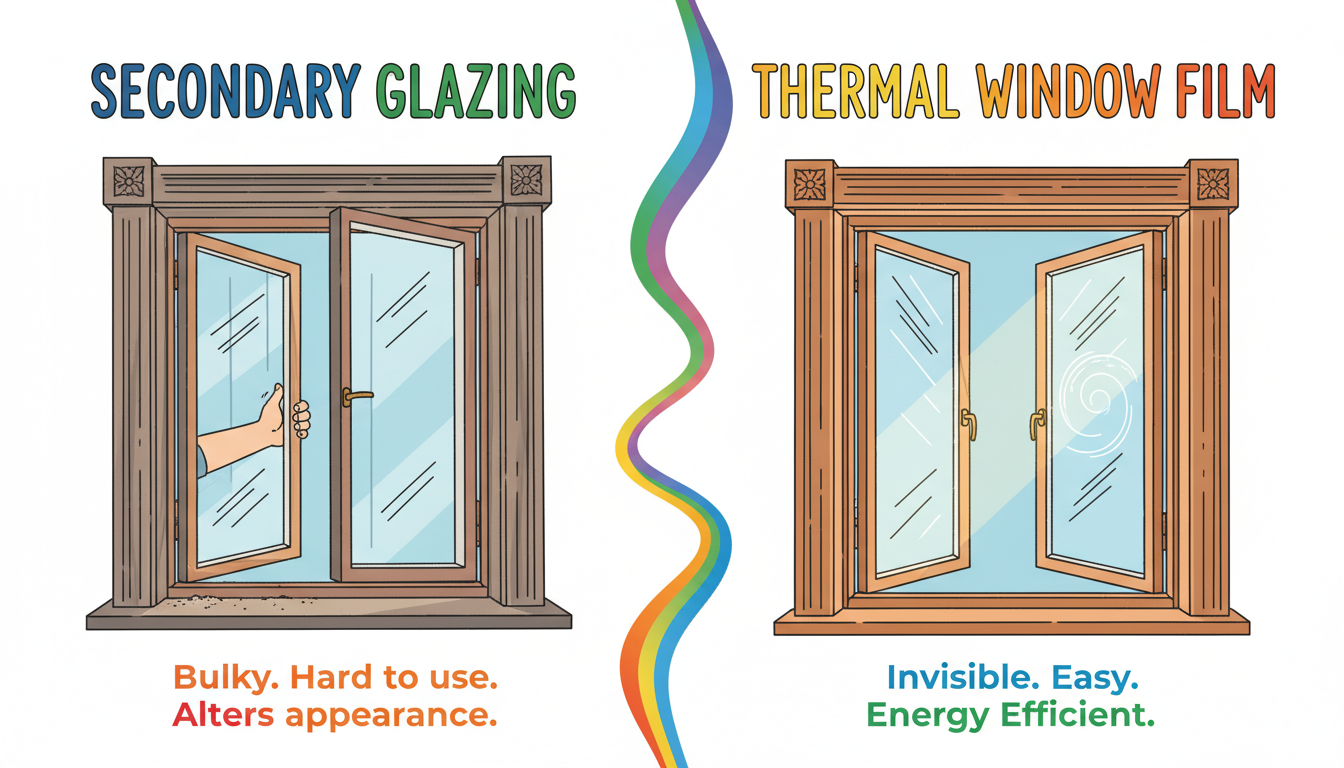
For homeowners in period properties across Oxfordshire, secondary glazing is a common recommendation. While it is effective, it involves adding a whole second window frame inside your original one. It’s bulky, it makes opening your windows a chore, and it can ruin the look of heritage timber frames.
Thermal window film acts as an "invisible secondary glazing." It provides the added warmth and heat loss reduction without the physical bulk. It is the ideal way to optimise the energy performance of your single pane glass or older double units without a visit from the planning office.
Technical Comparison: Film vs. Triple Glazing
When we look at the "Battle of the Products," the most common competitor to thermal window film is actually a full glazing replacement. People think they need to spend thousands on new triple glazing to solve their winter woes.
However, even the experts acknowledge that a high-quality thermal film can provide up to 30% heat loss reduction. When you compare the tinting cost to the cost of a full window replacement, the window film ROI is staggering. You are essentially achieving a "glazing upgrade" without the construction mess or the environmental waste of throwing away perfectly good glass frames.
Case Study: The "Wall of Glass" Challenge
In a recent project in High Wycombe, a client had a stunning modern extension with 6-metre wide sliding doors. In the summer, the room was a furnace; in the winter, it was like sitting next to a block of ice.
They initially looked at thermal roller systems, but the cost was astronomical, and the blinds would have required a massive housing unit that ruined the "rimless" look of the doors. By installing our insulating window film, we were able to:
-
Lower the u-value significantly.
-
Maintain the 180° view of the garden.
-
Provide solar protection that curtains simply cannot match.
This is the power of the "Invisible Renovation." It solves the energy problem while staying out of the way of the design.
Why Choose BucksTinting for Your Thermal Project?
At BucksTinting, we don't just "tint" windows; we engineer thermal environments. We are a specialist company that focuses entirely on architectural glazing. We don't do cars and we don't do vans. Our expertise is in the residential and commercial sector, ensuring that every installation is chemically compatible with your specific glass.
When we provide a residential window tint quote in Northampton or Buckinghamshire, we are looking at your home's orientation, your glass type, and your aesthetic goals. We take pride in the quality of our finish, no bubbles, no light gaps, just a perfectly clear, thermal shield.
Frequently Asked Questions
Is window film better than thermal blinds for heat retention? While both help, window film has the advantage of being "always on." You don't have to remember to close it to get the benefits. Plus, film allows you to keep your view, which blinds obviously do not.
Will it make my room look dark? Not at all. We offer thermal films that are virtually invisible. They are designed to allow maximum visible light in while purely targeting the "invisible" heat spectrum.
Can it be applied to triple glazing? In some cases, yes, but we always perform a thermal stress analysis first. Triple glazing has very specific heat-handling characteristics, and as experts, we ensure the film we choose is 100% safe for your glass.
Do you cover my area? We operate throughout Buckinghamshire, Oxford, London, Northampton, and Guildford. If you’re in the South East and want to optimise your home’s thermal performance, we are your local team.
Summary: Reclaim Your View, Retain Your Heat
You don't have to live in a dark room to stay warm. If you are looking for a thermal covering for windows that respects your home’s character and provides energy efficient results, window film is the clear winner.
Don't settle for "bulky" when you can have "brilliant." (And let's be fair, nobody ever stood in their lounge and said, "I wish I had more dusty fabric covering my expensive windows!")
Contact BucksTinting today for a bespoke residential window tint quote. Let's talk about your projects and find the perfect, invisible thermal solution for your home. Reclaim your architectural integrity and keep the heat where it belongs.