If you’ve spent any time looking out over the rolling hills of the Chilterns or enjoying a quiet morning in a sun-drenched breakfast room in Marlow, you know that the view is half the reason we live in this part of the world. However, that same beautiful sunlight can quickly turn your living room into a greenhouse and turn your expensive velvet sofa into a faded relic of its former self.
When it comes to managing heat, glare, and privacy, most homeowners find themselves at a crossroads: Window Film vs. Blinds.
As architectural window film specialists at BucksTinting, we spend our days helping people from Oxford to London navigate this exact choice. While window blinds have been the "go-to" for decades, modern technology has made window film a contender that doesn't just compete—it often wins. In this guide, we’re going to break down why window film might actually be the missing piece in your home improvement puzzle.
1. The "View" Dilemma: Why Blinds Might Not Be the Better Option
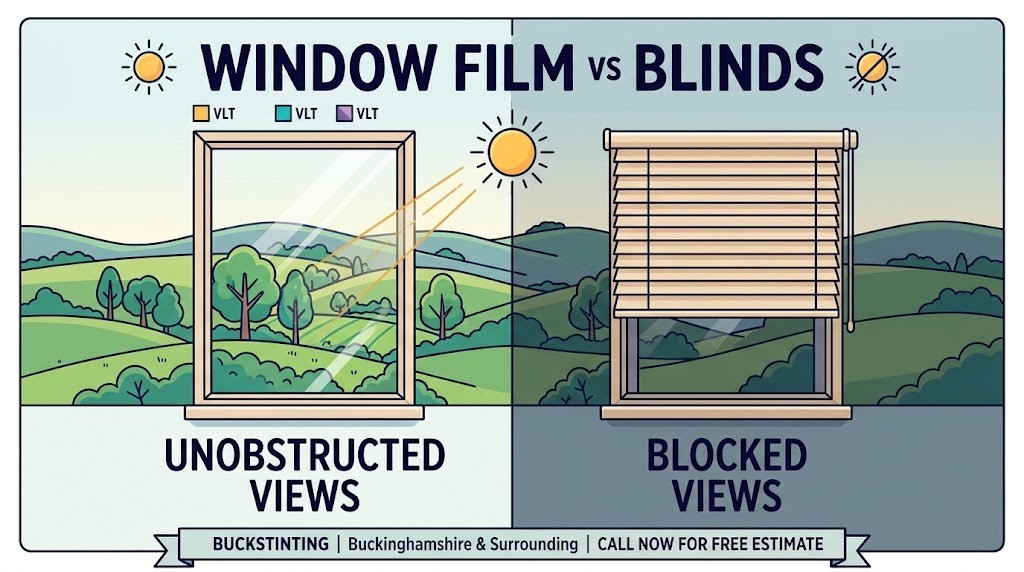
Let’s look at the biggest drawback of traditional window treatments: they work by getting in the way. Whether you have honeycomb blinds, wooden Venetians, or heavy rollers, their primary function is to block the window. In a beautiful Buckinghamshire home, blocking the window means blocking the very thing you paid for—the view.
Unobstructed Views vs. The "Caged" Feeling
When you install window film, you aren't adding a physical barrier. You are applying a high-tech, micro-thin layer directly to the glass. This provides glare reduction without blocking views, allowing you to keep the curtains open and the world visible.
Imagine it’s a bright Tuesday in Berkhamsted. With blinds, you have two choices:
-
Leave them open: Endure the blinding glare on your TV and the rising heat.
-
Close them: Sit in a dark room with the lights on at 2:00 PM, feeling like you’re in a submarine.
Window film offers a third way. It acts like a premium pair of sunglasses for your house. You get the protection and control you need without sacrificing the home's connection to the outdoors. Unlike window blinds, which can often feel like "bars" on a window when the slats are tilted, film is essentially invisible once installed. It preserves the architectural integrity of your windows while doing the heavy lifting of solar management.
2. Understanding VLT: Choosing Your "Shade"
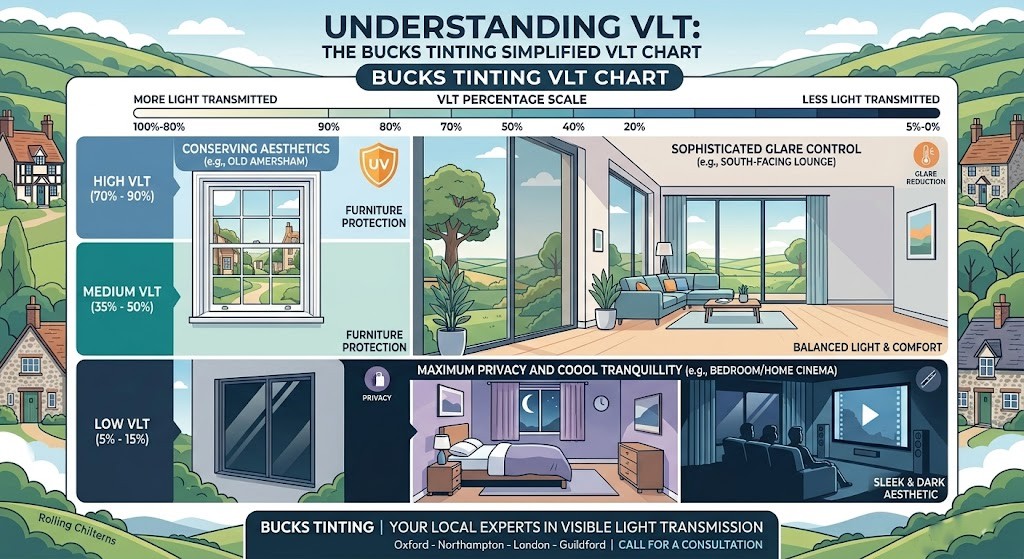
When we talk about different window tints, the most important technical term you’ll hear us mention at BucksTinting is Visible Light Transmission (VLT). Don't let the jargon intimidate you; it’s actually quite simple.
VLT is the percentage of light that the film allows to pass through the glass. To help you choose, we often refer to a visible light transmission (vlt) chart during our consultations. This is crucial because every room in your home has a different personality and a different requirement for light control.
-
High VLT (e.g., 70% or higher): These are nearly invisible to the naked eye. You get all the UV protection and significant heat rejection, but the window looks virtually unchanged. This is the better option for heritage homes or listed buildings in areas like Old Amersham where you don't want to alter the aesthetic but desperately need to stop the furniture from fading.
-
Medium VLT (e.g., 35-50%): A soft, sophisticated tint. It’s perfect for light control and taking the edge off a very bright, south-facing room. It provides a "finished" look to the glass without making the interior feel dark.
-
Low VLT (e.g., 5-15%): These provide maximum privacy and glare reduction. From the outside, they look sleek and dark; from the inside, they provide a cool, tranquil atmosphere. This is often the preferred choice for bedrooms or home cinemas where blackout capabilities aren't strictly necessary but high-level glare reduction is.
Choosing the right VLT is about balancing light control with the specific mood of the room. A kitchen might benefit from a high VLT to keep it bright and airy for cooking, while a home office in a south-facing room in Beaconsfield might require something much lower to stop the "screen squint" during Zoom calls.
3. The Science of Heat: Energy Efficiency Explained
In the UK, we have a bit of a "Goldilocks" problem with our weather. One week we’re desperate for a breeze, and the next we’re huddled by the radiator. Energy efficiency is a major factor in the window film vs. blinds debate, and it’s an area where the two options perform very differently.
How Blinds Handle Heat
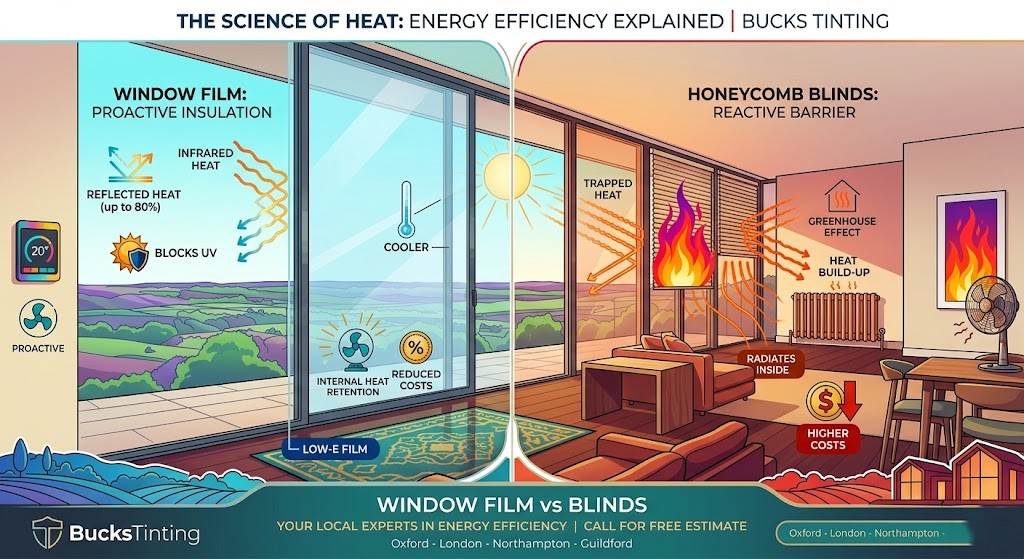
Window blinds—specifically honeycomb blinds—are decent at providing a layer of insulation. However, they have a fatal flaw in the summer: they trap the heat between the blind and the glass. That heat eventually radiates into the room anyway, causing the "greenhouse effect." While blinds can also block UV to some extent, they do nothing to stop the glass itself from heating up. Once the air between the blind and the window is hot, your room's temperature will inevitably rise.
How Window Film Handles Heat
Window film is designed to reflect solar energy before it even enters your home. By reflecting the infrared rays, the glass itself stays cooler. In the summer, high-performance solar films can reduce solar heat gain by up to 80%. This isn't just about comfort; it's about costs. If you have an air-conditioned home, your system won't have to work nearly as hard, leading to a noticeable difference in your energy bills.
In the winter, certain low-emissivity (Low-E) films can actually help retain internal heat, acting as an extra layer of insulation on your existing windows. When it comes to year-round energy efficiency, film is a proactive solution, whereas blinds are reactive. Window film might actually be one of the most cost-effective ways to upgrade single or older double-glazed units without the massive expense of replacing the entire window frame.
4. Privacy: The Modern Professional's Approach
We all value our privacy, especially if your home is overlooked by neighbours or faces a busy street. The traditional way to get privacy is to pull the blinds. But again, you lose your light and your sense of space.
The Privacy Window Evolution
Frosted window film or one-way privacy films provide a brilliant alternative for the modern home.
-
Frosted Window Film: Ideal for bathrooms or ground-floor privacy window needs. It lets in a beautiful, diffused glow while being completely opaque to prying eyes. Plus, frosted window film is extremely low maintenance compared to a fabric blind that will eventually succumb to mould in a damp bathroom environment.
-
Reflective (One-Way) Film: During the day, these films turn your windows into a mirror for people outside, while you enjoy a clear, crisp view of your garden. It’s the ultimate way to feel secure without feeling "walled in."
It is worth noting that film may not provide the same level of privacy at night when the lights are on inside and it's dark outside. At that point, the "one-way" effect reverses. This is one area where window blinds still hold a slight advantage. Many of our clients at BucksTinting use a "hybrid" approach: high-quality window film for daytime heat and privacy, and light curtains or blinds for evening blackout.
5. Maintenance: The Silent Time-Thief
If you’ve ever spent a Saturday morning with a damp cloth, individually wiping the dust off twenty-four slats of a Venetian blind, you’ll understand why we’re so passionate about film.
Window blinds are essentially a nightmare for anyone wanting dust-free window coverings. They trap allergens, pet hair, and grime. Over time, fabric blinds absorb smells—especially in kitchens—and wooden blinds can warp if they get damp.
Window film, once installed, requires nothing more than the occasional wipe with a soft cloth and soapy water. There are no fixtures to break, no cords for the cat to tangle itself in, and no hardware to screw into your pristine window frames. Window film doesn't require any hardware, making it the "cleanest" aesthetic choice for minimalist homes. It is a "fit and forget" solution that stays looking brand new for years.
6. A Room-by-Room Guide: Where Film Shines
Every room in your home has a different relationship with the sun. Here’s how window film compares to window blinds in specific settings across Buckinghamshire.
The Kitchen and Breakfast Room
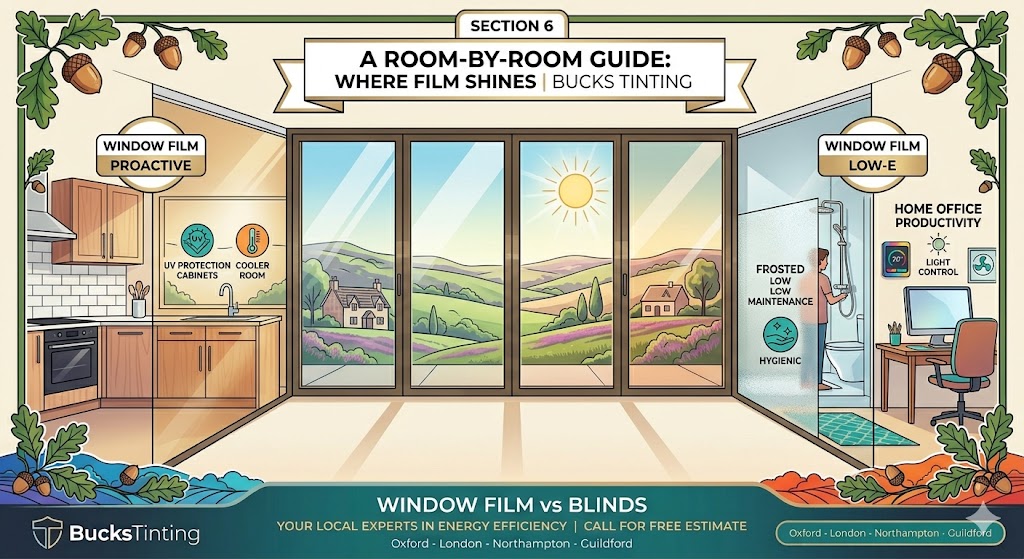
The kitchen is the heart of the home, but it’s also the place where you’re most likely to notice heat gain. Window blinds in kitchens are a magnet for grease and steam. Window film allows you to keep the room bright and airy for cooking while keeping the temperature down. It also protects your kitchen cabinetry from UV damage—something that is often overlooked until the wood starts to change colour.
The Home Office
With more of us working from home in places like High Wycombe and Gerrard's Cross, the home office has become a critical space. Glare on a computer screen is the enemy of productivity. Window film provides the light control you need to see your screen clearly without having to work in a dark room. It’s about control—you decide how much light comes in, rather than being at the mercy of the sun's position.
The Conservatory or Orangery
This is the classic "Bucks" dilemma. We love our glass extensions, but they are often too hot in the summer and too cold in the winter. Window film is arguably the only effective solution for these spaces. Blinds in a conservatory often look cluttered and collect dead flies (let's be honest about the British countryside!). Film maintains the sleek, glass-roofed look while making the room habitable 365 days a year.
The Bathroom
Moisture and fabric don't mix. Frosted window film is the gold standard for bathrooms. It provides 100% privacy while allowing you to enjoy a bright, natural morning light while you brush your teeth. It’s far more hygienic than a damp blind and much easier to keep clean.
7. The Costs: Installation, Longevity, and Value
When comparing costs, it’s easy to look at the price tag of a cheap roller blind and think you’re saving money. But let’s look at the long-term reality of home ownership.
-
Installation Costs: High-quality window blinds require professional measurement and fitting into the fixtures. This often involves drilling into walls or frames. Window film installation is a highly skilled, surgically clean process that requires no drilling and leaves no mess.
-
Durability: Quality window film tends to last longer than blinds. Our professional-grade films often come with a 10-year warranty. Blinds, especially those in high-sun areas, often need replacing every 5 to 7 years as the fabric rots or the mechanisms fail.
-
Furniture Protection: Because film blocks 99% of UV rays, it protects your carpets, artwork, and furniture from fading. This "hidden saving" can amount to thousands of pounds over the years. Think of it as an insurance policy for your interior design.
8. Tricky Windows and Architectural Challenges
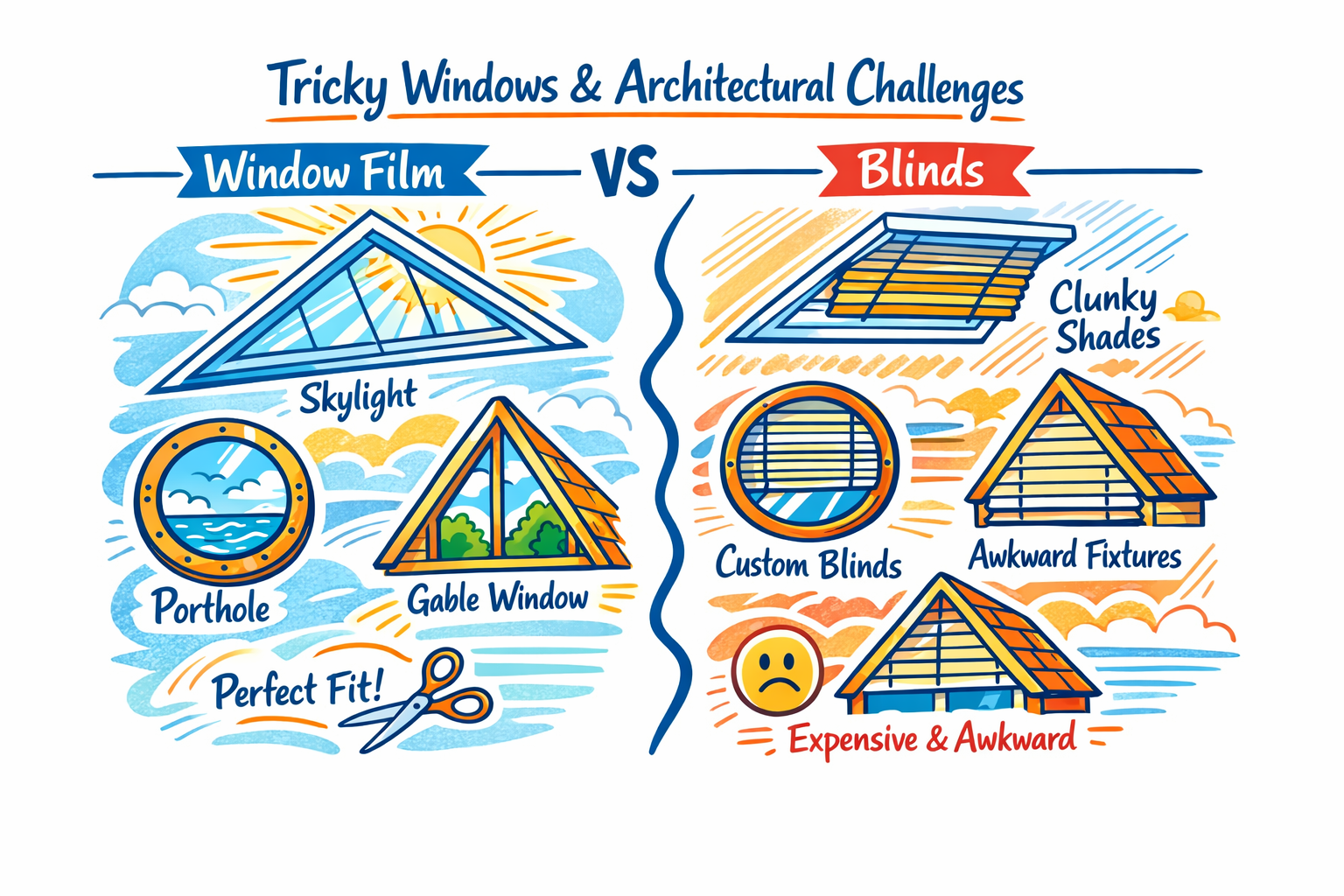
Every home in Buckinghamshire seems to have that one window. Maybe it’s a triangular gable end in a converted barn, a circular porthole in a coastal-style home, or a massive skylight in a vaulted ceiling.
Trying to find window blinds for these shapes is an expensive, custom-made headache. You often end up with clunky fixtures that ruin the architectural lines of the window.
Window film is the better option here because it is cut to the exact shape of the glass. Whether it’s a massive skylight pouring too much heat into your kitchen or a tiny decorative pane, the film fits perfectly. It provides control over the environment without distracting from the building's design. At BucksTinting, we relish these "impossible" windows—they are where our expertise really shows.
9. The Science of Solar Energy: Why It Matters
To truly understand why film is so effective, we have to look at the solar spectrum. The sun’s energy is made up of three parts:
-
Ultraviolet (UV) Light: The stuff that fades your furniture and damages your skin.
-
Visible Light: The stuff we see.
-
Infrared Light: The stuff we feel as heat.
Window blinds only really address the visible light. They don't do much to stop UV or Infrared. High-tech window film is engineered with multiple layers of exotic metals and ceramic particles that are "tuned" to reject specific wavelengths. This is why we can have a film that is almost clear but still rejects 50% of the total solar energy. It’s pure science, applied to your glass.
10. Thermal Stress: Why Professional Installation is Non-Negotiable
A common question we get is whether window film can cause glass to crack. The short answer is: if you buy a cheap DIY kit and stick it on the wrong type of glass, yes, it can. This is where the "Expert" part of BucksTinting comes in. Different types of glass—laminated, toughened, annealed, or double-glazed—expand and contract at different rates when they get hot. When we perform an installation, we carry out a thermal stress calculation. We ensure the film we recommend is compatible with your specific windows. This is a level of protection and peace of mind you simply don't get with a standard blind fitting or a DIY film project.
11. The Aesthetics: The Invisible Upgrade
Many of our clients in areas like High Wycombe and Marlow spend a fortune on high-quality aluminium or timber window frames. Why would you want to cover those beautiful fixtures with bulky window blinds?
Window film is the only "invisible" upgrade. It enhances the performance of the glass without changing the look of the house. From the kerb, your home looks sophisticated and uniform. Inside, the light control feels natural, not artificial. It’s the ultimate choice for the homeowner who values "understated luxury."

12. Local Expertise: Serving the "Golden Quadrant"
We aren't a faceless national chain. We are local specialists who understand the specific challenges of homes in this region. Whether you’re dealing with the hard water of the Chilterns or the intense afternoon sun on a South-facing patio in Guilford, we’ve seen it and solved it.
Our service area covers:
-
Buckinghamshire: From our base out to Aylesbury, High Wycombe, and the Chalfonts.
-
Oxfordshire: Bringing cooler homes to Oxford and Thame.
-
Hertfordshire: Serving St Albans, Berkhamsted, and beyond.
-
The M4 Corridor: From London out to Reading and up to Northampton.
When you choose BucksTinting, you’re choosing a team that knows that "one-size-fits-all" is a myth in the world of architectural glass.
13. Summary: Why Film Wins the Debate
While window blinds provide adjustable light filtering and blackout capabilities that are hard to beat in a nursery or a bedroom, for the main living areas of a home, window film is the superior choice.
To recap, window film offers:
-
Energy efficiency that lowers bills and reduces your carbon footprint.
-
Privacy that doesn't sacrifice your view of the garden.
-
A dust-free and hygienic environment for your family.
-
A "hardware-free" look that complements any interior design.
At BucksTinting, we take pride in every installation. We treat your home with the respect it deserves, ensuring a bubble-free, flawless finish every single time.
Reclaim Your View and Your Comfort
If you’re tired of living behind closed blinds and want to reclaim your view while keeping your home cool and protected, let’s have a chat. Don't let the British summer (or those surprisingly bright winter mornings) dictate how you use your living space.
We can help you navigate the visible light transmission (vlt) chart, explain the costs, and find the perfect film for your specific needs.