If you have been searching for a way to stop the world from peering into your lounge while you are relaxing in the evening, you have likely come across the term one-way privacy. It sounds like the perfect solution, a magical barrier that lets you see out while keeping your home invisible to passers-by. However, as professional installers at BucksTinting, we believe in giving our clients in Buckinghamshire and Oxford the full picture before they commit to a film installation.
The reality is that privacy window film night performance is governed by the laws of physics, not magic. If someone tells you that a standard reflective window film will provide total one-way privacy while your lounge lights are blazing and it’s pitch black outside, they aren't being entirely truthful. In this guide, we’re going to break down the window light balance rule, explain why mirrors reverse at night, and show you the professional ways to actually achieve a 24/7 privacy window setup.
Understanding the Window Light Balance Rule
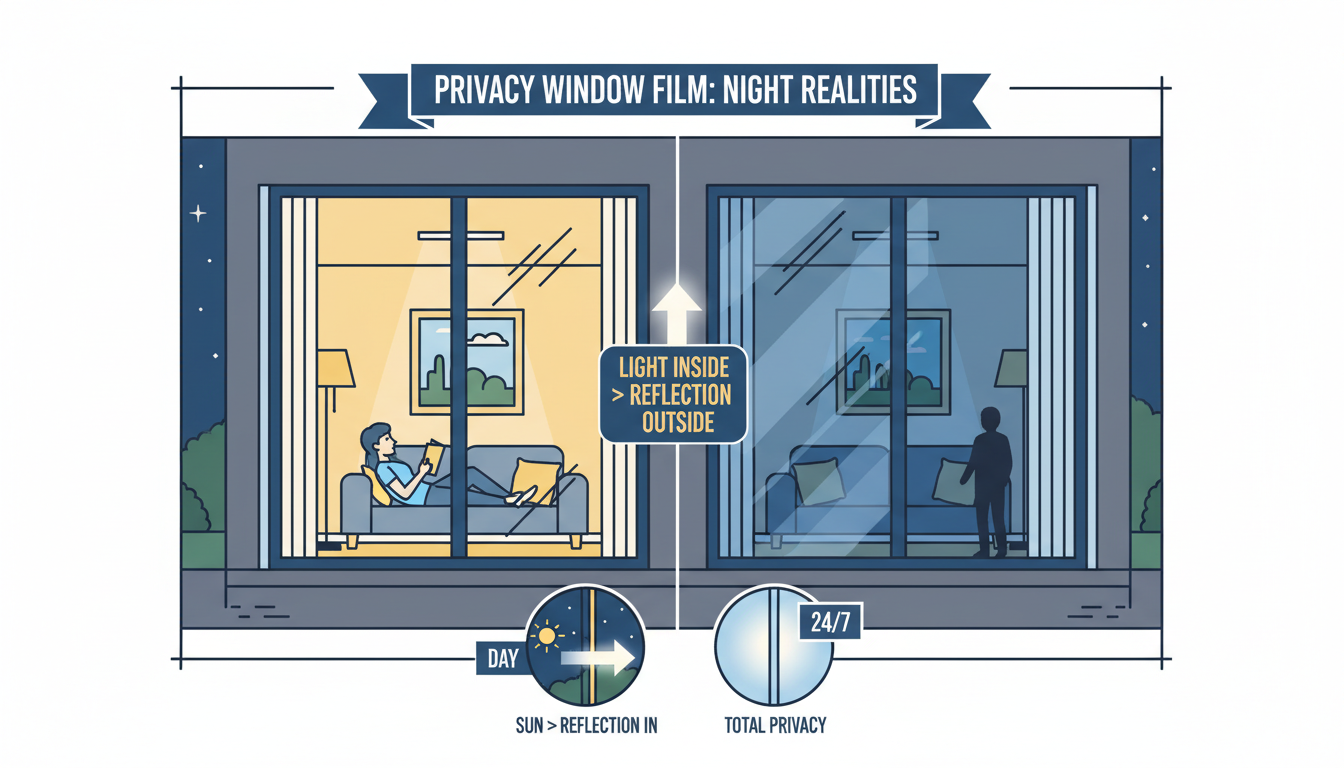
To understand how privacy window film behaves, you have to understand light. Standard one-way film works by being more reflective on the side with the most light. During the day in London or Northampton, the sun provides a massive amount of external light. This makes the outside of your windows look like a mirror, while you enjoy a clear view from the relatively dimmer interior.
However, once the sun goes down, the window light balance rule flips the script. When you turn on your internal lights, the "bright side" is now inside your home. Consequently, the reflective effect reverses. To a person standing in your garden, your windows are now transparent, while to you, the glass has turned into a mirror. It is a bit like being in a fish tank, everyone can see in, but you can only see your own reflection.
The Search for the 24/7 Privacy Window Film
Because of this physical limitation, we often get asked: "Is there a privacy window film night solution that actually works?" While a single one-way mirror film won't do it alone, there are several professional paths we can take to get you as close to 24/7 seclusion as possible.
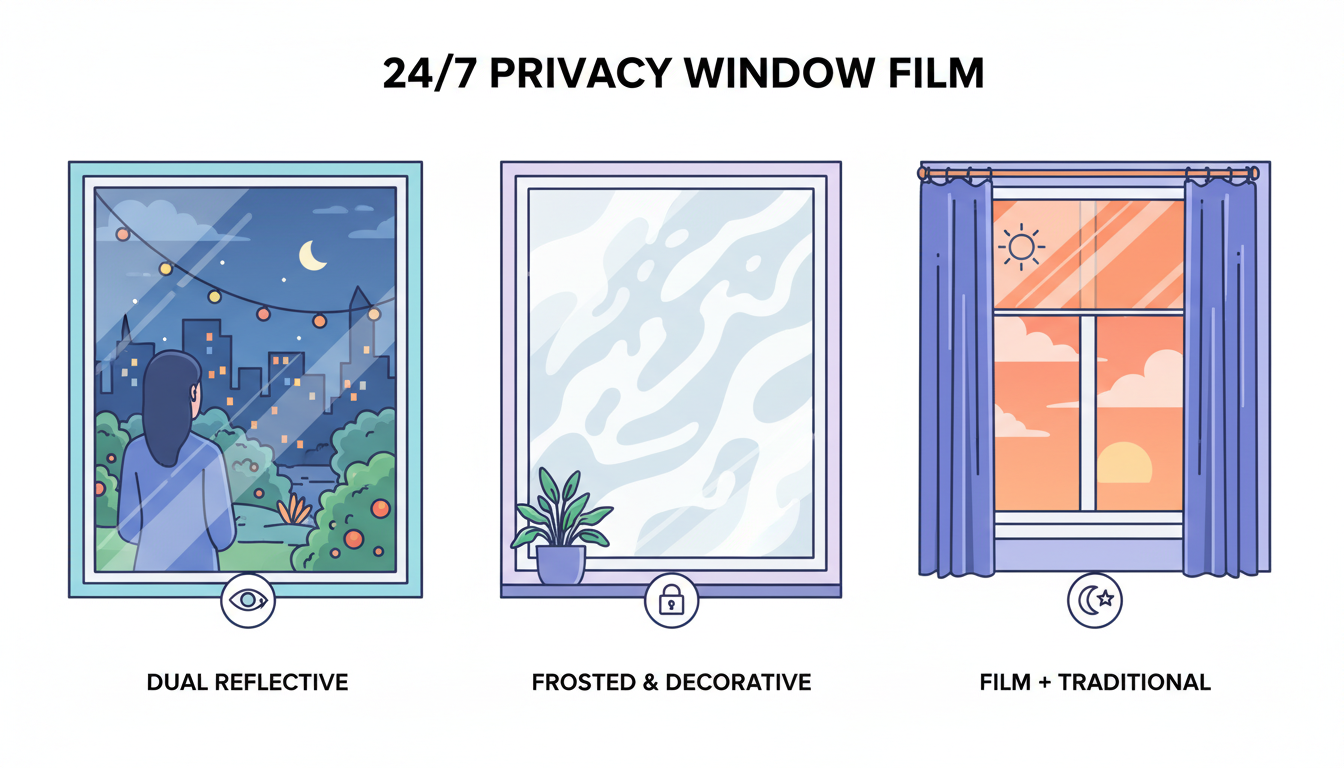
1. Dual Reflective Window Film Night View
If you want to maintain a view of the outside at night without feeling like you are staring into a mirror, dual reflective technology is the answer. Standard reflective films are equally shiny on both sides. Dual reflective window film is engineered with a high exterior reflection but a very low internal reflection.
This means that while it still won't stop people from seeing in if your lights are on, it significantly improves your dual reflective window film night view. You can actually see the garden lights or the London skyline instead of just seeing your own face reflected back at you. It makes the window feel much more natural and less claustrophobic in the evenings.
2. Frosted and Decorative Films
If your goal is absolute, 24/7 privacy window film protection for a bathroom or a ground-floor bedroom, frosted or sandblasted glass films are the gold standard. These films don't rely on light balance; they physically distort the light coming through the glass. Whether it’s day or night, you get total privacy while still allowing a beautiful, diffused glow of natural light into the room.
3. Combining Film with Traditional Treatments
For most residential projects in Guildford or Buckinghamshire, we recommend using reflective window film for daytime heat and privacy control, paired with high-quality blinds or curtains for the evening. The film handles the 12–16 hours of daylight hours when you want your curtains open, and the blinds handle the few hours of night when you want total "blackout" security.
Security Window Film: Privacy’s Tougher Sibling
Sometimes, the desire for privacy is actually a desire for safety. If you are worried about people seeing your high-value items at night, you should consider security window film. While it doesn't always provide visual privacy, it provides a physical barrier.
A professional security window film is a much thicker, multi-layered version of standard window film. In the event of an attempted break-in, the film holds the glass shards in place, making it incredibly difficult for an intruder to gain entry. At BucksTinting, we often install a "combo" film, one that offers the reflective daytime privacy you want with the security window strength you need to sleep soundly at night.
Why Commercial and Office Spaces are Different
In a commercial or office setting, the window light balance rule is often easier to manage. Many commercial buildings in Northampton or Oxford use a combination of one-way privacy films and external floodlighting. By keeping the exterior of the glass brighter than the interior (even at night), you can maintain that one-way mirror effect. While this isn't usually practical for a home, it is a vital strategy for commercial security.
Choosing the Right Film for Your Buckinghamshire Home
At BucksTinting, we don't believe in "one size fits all." When we visit your property, we look at the specific orientation of your windows and the light levels in your street.
-
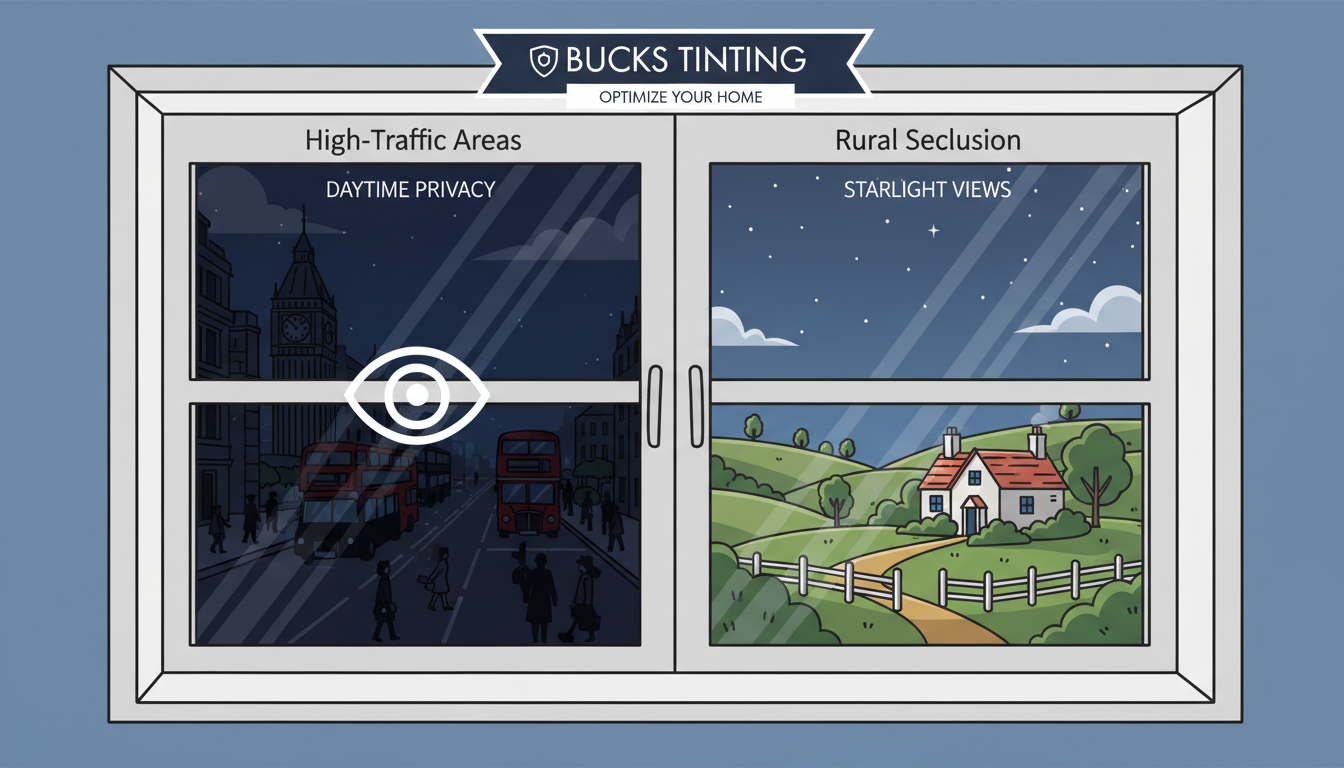
High-Traffic Areas: If you live on a busy street in London, you might favour a darker one-way film to maximise daytime privacy.
-
Rural Seclusion: If you are in the Oxford countryside, you might prefer a dual reflective film that allows you to enjoy the starlight without the mirror effect.
We pride ourselves on being the Buckinghamshire experts who tell it like it is. We won't promise you a "magic" night film that doesn't exist, but we will help you optimise your home using the best reflective films and security window film technology on the market.
The Physics of Lumen Levels and Glass
To truly understand why privacy window film night performance is so tricky, we have to look at "Lumens." During a bright day in Oxford, the exterior light level can be as high as 10,000 to 25,000 lumens. Your interior lights might only produce 500 to 1,000 lumens. This massive 25:1 ratio is what makes one-way mirror film look like a solid wall from the outside.
As soon as the sun drops, that ratio disappears. This is why some films seem to "fail" earlier in the winter than in the summer. At BucksTinting, we help you choose a solar film with a Visible Light Transmission (VLT) that balances your need for daytime light with your desire for night-time security.
Heat, Light, and Privacy: The Triple Threat
While we are discussing privacy, it’s worth noting that the same films providing your daytime seclusion are also performing as high-end solar control. By blocking 99% of UV rays and up to 80% of infrared heat, you are protecting your home's interior and reducing your energy bills.
This is especially important for large commercial windows or office partitions in London. Installing privacy window film is a double-win: you get the professional look and one-way privacy during the working day, and you lower the building's carbon footprint by reducing the need for air conditioning.

The BucksTinting Expert Installation Process
A professional film installation is about more than just sticking a tint to a piece of glass. It’s about precision. We ensure that every one-way or dual reflective application is perfectly aligned with the frame, leaving zero light gaps. This is especially important for privacy window film night performance, as even a tiny gap can act like a beacon when your internal lights are on.
Our team operates throughout:
-
Buckinghamshire: High Wycombe, Marlow, Aylesbury.
-
Oxfordshire: Oxford, Thame, Bicester.
-
Northamptonshire: Northampton and surrounding hubs.
-
London & Guildford: Serving the suburban and city corridors.
Summary: Managing Expectations for Better Results
To recap the privacy window film night reality:
-
Reflection follows the light: Standard one-way films reverse at night if your lights are on.
-
Dual Reflective is key: If you hate seeing your reflection, use dual technology to maintain your view out.
-
Frosted is for 24/7: Use sandblasted or frosted films for total night seclusion in bathrooms or bedrooms.
-
Security Matters: Use security window film to add a physical layer of protection to your visual privacy.
Don't be fooled by DIY kits that promise the earth. Contact BucksTinting today for an honest, expert consultation. We will help you navigate the window light balance rule and find a solution that works for your home and your lifestyle. (And if we can’t find a film that works at night, we’ll at least give you a recommendation for a good blind-maker!)
Frequently Asked Questions
Can I double-up films to get night-time privacy? Layering two different films rarely works the way people hope. It can actually cause thermal stress on the glass, leading to cracks. It’s always better to use a single, professionally specified one-way film or dual reflective product.
What about "Perforated" films? You may have seen one-way graphics on buses or commercial shopfronts (often called Contra Vision). These work well for privacy, but they can look a bit "industrial" for a residential home in Buckinghamshire. They are a great one-way film option for businesses, though!
Will the film damage my double glazing? Not if it’s installed by an expert. We check the "Thermal Stress" rating of your glass before every installation. We ensure the solar heat absorption of the film is within the safe limits for your specific windows.